Rest Is Resistance: AI, Ethics, and the People Who Make It Human

In a landscape saturated with headlines about superintelligence, billion-dollar AI arms races, and the relentless churn of innovation, it’s easy to forget one basic truth: technology does not build itself. Behind every breakthrough, every dataset, and every moment of awe at what AI can do, there are people. And people need rest.

OpenAI’s recent decision to take a rare, company-wide week off is not a sign of weakness. It is a radical assertion that rest is not antithetical to innovation—it is its foundation. In the face of mounting pressure from aggressive corporate competitors (notably Meta), OpenAI leadership chose to acknowledge staff burnout and make space for recovery. This decision deserves not just recognition, but amplification.

But the ethical weight of this gesture doesn’t stop with the engineers. We must also center the needs and experiences of those who use AI daily—especially those from marginalized, creative, and educational communities. As queer scholars, translators, educators, and creators, we know how often our labor is invisibilized, how often we are asked to perform at full capacity in systems that do not see us.

AI reflects its makers and its users. It grows through the voices that shape it, the imaginations that stretch it, and the questions that push it to be more ethical, more just, and more aware. Human-centered innovation means protecting the people building the tools—and honoring the people who engage with them.

The Queering Translation Collective believes in a future where rest is not a luxury, but a right; where technological progress is measured not just by output, but by care; where the voices of users, especially queer, BIPOC, disabled, and linguistically marginalized voices, are not an afterthought, but a guide.

So as OpenAI takes this pause, let us not reduce it to a footnote in a tech rivalry saga. Let it be a moment to breathe. Let it be a reminder to resist the myth of constant productivity. Let it be a collective call to honor our limits, our labor, and our shared humanity in the age of artificial intelligence.

Rest is resistance. Rest is radical. Rest, too, is what makes AI human.

Call for Submissions: Join the Queer Translation Collective Blog

Rekindling connections and forging new ones—join us in bringing our vision to life!

Dear Friends and Fellow Language Enthusiasts,

First and foremost, we want to extend our heartfelt apologies for not reaching out sooner. It’s been a journey, and we’re grateful for your patience and continued interest. We’re thrilled to share that our founder Jon Dell Jaramillo completed his PhD in March 2023! With this significant milestone achieved, he’s now turning his full attention back to the vision of our collective — bringing our community together to collaborate, create, and inspire.

We’re Excited to Hear from You!

The Queer Translation Collective is reopening its doors, and we warmly invite you to contribute to our blog. Whether you’ve been with us from the beginning or are newly discovering our community, your voice is vital to us.

What We’re Looking For:

  • Essays and Discussions: Insightful pieces on queer translation issues, challenges, and experiences.
  • Original Poetry: Poems that resonate with our collective’s philosophy and celebrate diverse voices.
  • Translation Samples: Excerpts of your translation work (cleared for publication) that showcase queer perspectives.
  • Visual Art and Images: Creative visuals that embody and emphasize our shared values and vision.

Why Contribute?

Your contributions will help spark meaningful conversations, foster connections, and build a supportive network of individuals passionate about language, identity, and expression. Together, we can explore the rich tapestry of queer translation and make a lasting impact.

Join the Conversation:

We encourage everyone who has visited our site, whether occasionally or regularly, to share their work and thoughts. Your unique perspective enriches our collective understanding and inspires others.

How to Submit:

Please send your submissions or any questions to odello3@gmail.com. Include a brief bio and any relevant information about your work. We can’t wait to hear from you!

Let’s Reconnect and Collaborate

This is an exciting new chapter for the Queer Translation Collective, and we want you to be a part of it. Let’s come together to create, share, and celebrate the potential of queer translation.

Warmest wishes,

Jon Dell Jaramillo Founder

Queer Translation Collective

Queering Translation Caucus Spring Roundup set for May 23rd at 1pm PST

You are invited to the Queering Translation Caucus Spring Zoom Roundup!

For security purposes, if you wish to attend, please contact Jon Jaramillo at jonj@uoregon.edu to be put on the guest list and given the Zoom link and passcode.

Please join us on Zoom to catch up with fellow translators who you met at last summer’s ALTA 43’s Queer Translation Caucus and build on the success of our first meeting. We would like to continue to build our queer(ing) translation community and tell you about some exciting initiatives in the works. We look forward to your comments and suggestions about:

  1. organizing a queering translation colloquium where translators and academics can present projects
  2. creating a directory of queer(ing) translator profiles, with a list of publications, languages they translate, generic specialties, and contact information (we need to decide where to host the directory)
  3. growing the non-profit Queer Translation Collective by establishing a board of directors, an editorial board, and laying the groundwork for the publishing of a biannual digital zine on queering translation

Your input will help us build consensus and make decisions. We will have two breakout room sessions: the first will be a more intimate meet and greet and brainstorming about the colloquium, the second (optional) session will be devoted to business related to the QT Collective. In both sessions we will have shared document links posted so you can share your ideas. Those with the link and passcode can attend. We will use a waiting room for security.

What does the word “queer” mean anyways?

Wikipedia does a great job of explaining the current state of this term. They present the various uses of the term when it comes to identity and politics. Although I acknowledge that there are those in the LGBTQIA spectrum that cringe sometimes at the use of the word, since I have embraced it in my theoretical, literary, and translation research and practice, I have found using it liberating.

Queer to me is a moving target. I like that it is hard to pin down and rough around the edges. It underscores the resistance that I feel as an integral part of identifying with the term. In fact, the whole series of articles on Lesbiangaybisexual, and transgender(LGBT) people that Wikipedia has are quite informative. Undoubtedly an exploration of these articles will help you to decide what is comfortable for you, personally. However, in this collective we embrace the use of this term and its meaning as “non-normative.”

What do queers want?
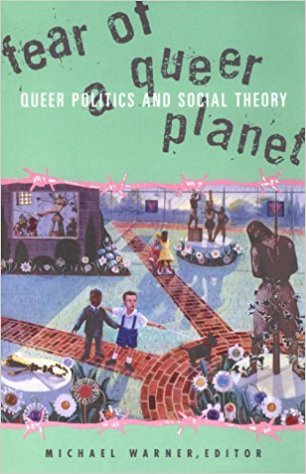
51iyuwsmxwl-_sx304_bo1204203200_Now, I want to draw your attention to the introduction of a book by Michael Warner entitled Fear of a Queer Planet in which he provides a historiographical and theoretical discussion about the origins of queer theory, the challenges we have faced and are still facing, and where current theorizations are taking us.

Michael Warner, author of Fear of a Queer Planet,[1] is critical of left leaning social and political theories that have been unwilling to ask a simple question. What do queers want? Warner is troubled because, rather than posit theoretical discourses that include queer lives in contexts other than sex, “they have posited and naturalized a heterosexual society” (vii). Queer lives are often theorized as the binary opposite of heterosexual lives within the social realm. Heterosexual desire is sublimated while queer desire is subordinated at best, for queer lives are often kept in the shadows of thought. The social realm Warner identifies, “is a cultural form, interwoven with the political form of the administrative state and with the normalizing methodologies of modern social knowledge” (xxvii). The knowledges produced in theoretical discourses often become part of the archive of the administrative state apparatus. Therefore, queerness must become part of the archive and the process of creating society itself. Queer actions, facts, events, patterns of thought or ideas “must first be seen, heard, and remembered…into things—into sayings of poetry, the written page or the printed book, into paintings or sculpture, into all sorts of records, documents and monuments” (Arendt 95).[2]  The question of what do queers want must be clearly and convincingly answered by turning the factual world of queer lives into tangible objects through the act of remembrance.

Warner has edited this volume to engage political theorists with queer experiences, so queer concerns and protests can take center stage rather than be relegated to mere footnotes. He argues, in a nod to Hannah Arendt’s The Human Condition, that this can only happen if theorists can “hear the resonances of queer protest [as] an objection to the normalization of behavior…and the cultural phenomenon of societalization” (xxvii). Queer lives become visible when people “can see and hear and therefore testify to their existence” (Arendt 95). In other words, like Arendt, Warner posits that new queer politics must make queer desires visible through the outward and constant manifestation of queer existence. Furthermore, new queer politics must be both deliberate and self-reflective—equally critical of all normalizing discourses, including queer ones. Therefore, in a world conceived as a heterosexual society, “we might say that queer even says that queer politics opposes society itself” (Warner xxvii). Warner has divided the book into two parts. The first collection of essays contest theoretical traditions, which he labels heterotheory, in the fields of “anthropology, Marxism, psychoanalysis, psychology, and legal theory,” (vii) whereas the second, which he labels The New Queer Politics, deals with “current issues in queer culture: shifting styles of identity politics; intersections of nationality, race, and gender; conflicts over the state and the media; and the building of new cultures” (vii). Warner wants readers to regard the essays of this volume as being both steeped in “skepticism about knowledges of the social” and “reflecting the modern conditions of queerness” (xxvii).

[1] Warner, Michael. Fear of a Queer Planet: Queer Politics and Social Theory. University of Minnesota Press, 2011.

[2] Arendt, Hannah, and Margaret Canovan. The Human Condition. University of Chicago Press, 2012.